
English experimental filmmaker, Ben Rivers, originally published his 2015 film, The Sky Trembles and the Earth is Afraid and the Two Eyes are Not Brothers. Considered to be more narrative and a departure from Rivers’ previous films, it is a dramatization of Tangiers based American expat Paul Bowles’ 1947 short story “A Distant Episode.” The plot of the film revolves around the main character played by Oliver Laxe, an avant-garde filmmaker of French descent but raised in Galicia, Spain. Set in Morocco, the dream-like atmosphere of the film follows Laxe as he descends into subjugation of a band of nomads when he abandons the set of his latest docu-fiction film The Mimosas.
The first half of the film follows a slower pace depicting Laxe and his crew in the process of shooting The Mimosas. Shot more abstractly and with minimal dialogue, the first half of the film gives the viewer little to work with to make sense of the story line. Placing higher importance on the visuals and the aesthetic, it sets a certain tone for the rest of the movie. The story line then deviates when it follows an unexpected turn of events after Laxe strays away from the set driving off into the desert, he is then kidnapped by Reguibat nomads, later attacked and tortured as his tongue is then cut off. While being held against his will in obvious suffering, he is clothed in a hand sewn rusty opalescent suit made of tin can lids becoming an ‘ornamental slave.’ Becoming a walking wind chime, the avant-garde director becomes objectified and seen as a source of entertainment by being repeatedly ask to dance. Slowly losing perception of reality and time while being held in captivity he is then sold away by promoting his dancing skills, only to refuse to dance for the buyer and be made fun of by the the musicians surrounding him. Upset because he feels as though he was tricked, the buyer confronts the nomads and is killed for demanding the money be returned. The nomads then escape into the desert, leaving Laxe curious about the potential of escaping. Later, seeing there is nothing in between him and freedom, he escapes his holding cell and escapes into the desert. fin.

Paul Bowles’ “A Distant Episode” follows the story of a linguistics Professor in the fictional city of Ain Tadouirt. The beginning of the short story differs from the book as it is assumed he is an Arabic scholar, the professor searches for Hassan Ramani and learns he has passed away. Encountering many uncomfortable experiences with the locals, the professor asks for the help of a qaouaji where he tells the professor to follow a path. While wandering alone he attacked by a wild dog and then similarly to the film had his tongue removed, attacked, and enslaved by Reguibat nomads. Later sold, and objectified the new owner is upset with his purchase to confront and decapitate one of the merchants. While the new owner is gone, the Professor frantically escapes, running into the town.
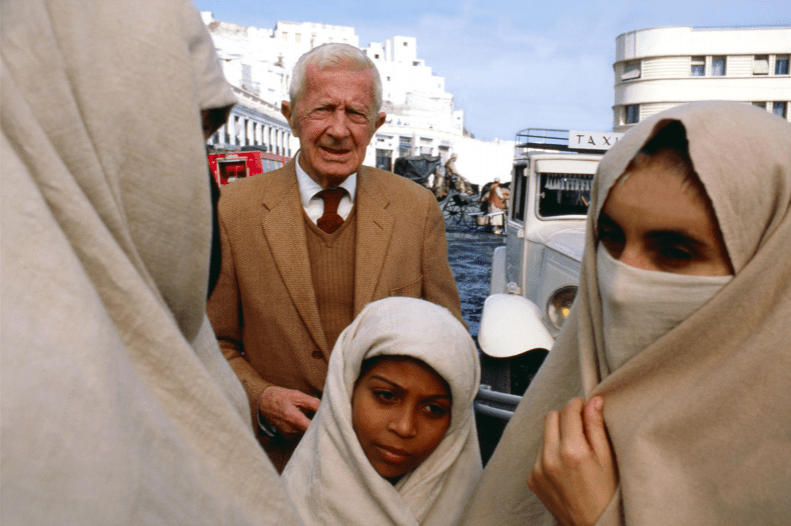
Linking a clearer inspiration with “A Distant Episode,” the second half of the film highlights the subtext on post-colonial retribution and the nature of authorship as describes by Guy Lodge in Variety. The film becomes a self-reflection for River’s study of cultural appropriation in which those appropriated regain their autonomy through the kidnapping and severing of the appropriator, in this case Oliver Laxe. Being French and raised in Spain is a play on the colonization itself by choosing Laxe as the main character, as he embodies both colonizing powers of Morocco. The act of attacking, kidnapping, and selling him objectifies and commodifies the colonizer leaving him vulnerable, reversing the roles of the colonizer and the colonized. The severing of the tongue is symbolic in itself as it represents communication and sensuality in combination with what seems to be his breakdown during captivity during the frustration of being forced dance. The acts play into the torture-porn subgenre as Laxe is stripped of humanity and dignity rendering him ‘a bare life’ in a place with what seems a place with no escape (as theorized by Giorgio Agamben.) By portraying the colonized as the subjugators of mental and physical torture it plays into the stereotype of the colonized as primitive and sexually deviant, leading many to perceive the short story as Orientalizing such as theorist Edward Said.
 Home
Home 